
IESE MBA 2025: Consulting at 48% and 42% at the Same Time
IESE publishes the highest consulting share in our corpus and no salary at all. Its own page carries two consulting figures for one class, six points apart.
- IESE reports consulting at 48 percent of the class of 2025 by function and 42 percent by sector, on one page, for one class, with no comment on the gap.
- That 42 percent is the second-highest consulting sector share we have profiled, behind INSEAD at 50 percent, and the school publishes no salary figure in any currency to sit beside it.
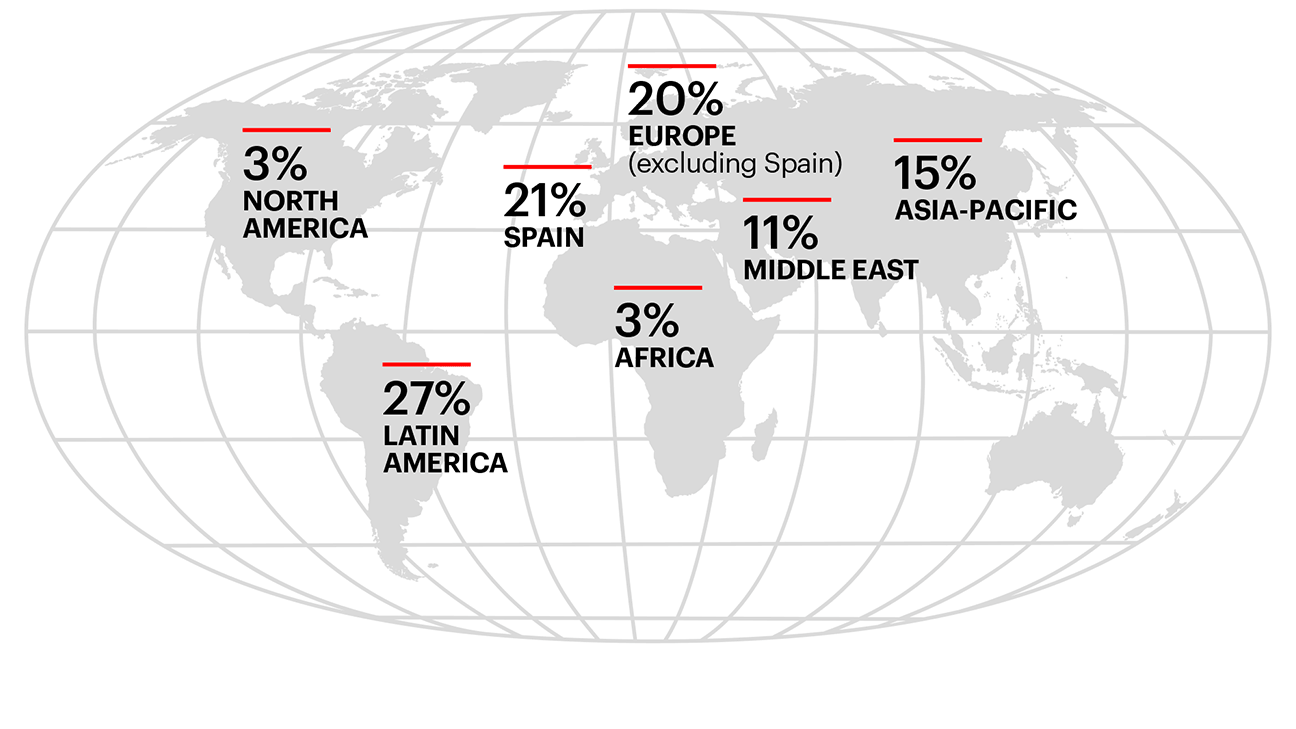
- Europe takes 41 percent of the class once Spain and the rest of Europe are added together. Latin America alone takes 27 percent.
- The regional split is published only as an image with empty alt text, so a text-only reading of the page finds that section blank.
- IESE publishes a first-year case competition that it says gives direct exposure to three named strategy firms and often fast-track recruitment options. That claim is the school's, and none of the three firms publishes it.
IESE sends more of its class into consulting than almost any school we have profiled, and it publishes the share twice. The class of 2025 reads 48 percent consulting by function and 42 percent by sector, in two charts stacked on one page. The school publishes no salary anywhere to go with either of them.
Forty-eight or forty-two, on one IESE MBA page, for one class
The career impact page, checked 1 October 2026, carries a block headed "Full-time employment Class of 2025" with three breakdowns under it. Two of them contain consulting.
| Class of 2025 | Consulting share |
|---|---|
| By function | 48% |
| By sector | 42% |
Both charts close on 100 by themselves. The function chart runs Consulting 48, Sales and marketing 17, Finance 16, General management 8, Operations and logistics 7, Information technology 2, Human resources 1 and Other 1, which sums to 100. The sector chart has four rows only: Consulting 42, Diversified Industries 33, Finance 16, Technology 9, which also sums to 100.
The six point gap carries the same meaning it carries at every school in this batch. A sector figure counts graduates who joined a consulting firm. A function figure counts graduates doing consulting work, which includes internal strategy roles inside companies that sell something else. About one graduate in sixteen of this class is in the second group.
IESE does not comment on the difference. IMD labels its equivalent row "Consulting (internal & external)", which tells a reader in four words what is happening. Our IMD page works through that comparison. At IESE you have to notice the two charts and read their headings.
The figure to use depends on the question. If you are asking how many people this school sends to consulting firms, the answer is 42 percent. If you are asking how many end up doing consulting work of any kind, it is 48.
Reading about a consulting firm is not preparing for a consulting firm.
Take the readiness checkA very high IESE MBA consulting share, and the missing number
Forty-two percent by sector is the second-highest figure in our corpus. Only INSEAD is above it, reporting management consulting as the destination of 50 percent of its 2025 graduates, which our INSEAD page sets out. That places IESE well clear of the American schools we have profiled, and it is the first thing a consulting-focused applicant should know about it, with the caveat that the full set of published consulting shares rests on denominators no two schools share.
It is also the point where the school stops. There is no salary figure anywhere on the career impact page, in any currency, for any sector. No base, no median, no range, no sign-on bonus. The MBA 2025 employment report exists and the download button leads to a marketing form on a separate host, which we do not fill in to obtain a source.
| What IESE publishes openly | What it does not |
|---|---|
| Consulting share, two ways | Any salary, in any currency |
| Regional destinations, seven ways | A salary reporting rate |
| More than 300 recruiting companies | Which companies, with two exceptions |
| 80 percent job placement | The denominator behind that 80 percent |
| 52 percent of opportunities sourced through the school | A hire count for any firm |
This makes IESE the mirror image of HEC Paris, which publishes salary tables down to the sector and location while reporting a consulting share a third of IESE's size. Our HEC Paris page shows what a full salary disclosure looks like from a European school, which is useful precisely because IESE offers none.
The practical consequence is blunt. Any page quoting an IESE MBA salary got the number from somewhere other than IESE, and it should say where. We do not have one and we are not going to estimate one.
One of the six headline tiles on the page is worth reading carefully, because it is the only one that is not about IESE. Its label reads "Salary increase for European Schools after 3 years of graduation according to Financial Times 2026". That is a figure about European schools collectively, attributed to a ranking publication. We do not reproduce numbers taken from ranking media, and in this case the label alone is the useful part: the school's most salary-adjacent public statistic is not a statistic about the school.
Where the class went, and why a text reader sees nothing there
Under the same heading, the page carries a third breakdown labeled "By region". Read the page with any text tool and that section is empty. The data is a PNG published with an empty alt attribute, so every extraction method returns the heading and nothing under it.
We downloaded the image and read it. Here is what it says.
| Region, class of 2025 | Share |
|---|---|
| Latin America | 27% |
| Spain | 21% |
| Europe excluding Spain | 20% |
| Asia-Pacific | 15% |
| Middle East | 11% |
| North America | 3% |
| Africa | 3% |
The seven shares add to 100: 27 plus 21 plus 20 plus 15 plus 11 plus 3 plus 3.
Two readings follow. Spain and the rest of Europe together make 41 percent, so a school in Barcelona places under half its class in Europe. And Latin America at 27 percent is the single largest region on the map, ahead of Spain at 21, and ahead of Asia-Pacific and the Middle East added together, which make 26. Latin America and Asia-Pacific together reach 42 percent, one point above all of Europe.
One caution belongs here and it is not small. The image carries region names and percentages and nothing else. The school does not define whether "By region" means where graduates work, where they are from, or something else. It sits under an employment heading, which is the reason to read it as work location, and the school never says so. We quote it as the school labels it.
North America at 3 percent is the lowest share of any school in this batch, and it is the figure most likely to surprise an applicant who thinks of consulting recruiting as a transatlantic market.
The MBA consulting case competition built around three firms
IESE publishes something on this page that no other school in the batch publishes: a named pipeline into strategy consulting, described in its own words.
The school writes that "The MBB Case Competition is the first major Case Competition of the year, and simulates the high-pressure environments of Strategy Consulting, giving students a platform to sharpen analytical thinking, teamwork, structured communication, and executive presence." It is run for first-year students, before internship recruiting.
Then it makes a stronger claim. The page states that the competition "offers a direct exposure to the leading Strategy Consulting firms McKinsey , BCG , and Bain & Co ., providing first year MBAs with real networking opportunities, mentorship, and often, fast-track recruitment options."
That sentence is the school's, about three firms, and none of the three publishes anything like it. We searched our firm research files for any published statement about a fast-track route through a school case competition and found none. So the accurate reading is that IESE says this and the firms have not said it, which is a different thing from saying it is untrue.
The page also states what it believes the firms get: "Early Engagement with Top Talent: By hosting the competition early, MBB firms gain first access to high-potential students before internship recruiting peaks." That is the school describing a third party's motive, which is exactly the class of claim our process tells us to attribute rather than assert.
What a first-year student can take from this is concrete and does not require believing the strongest version. A named competition runs early in year one, it is built around consulting cases, and the school schedules it before internship recruiting opens. Whatever it is worth as a shortcut, it is a deadline, and it lands earlier than most incoming students plan for.
A two-year clock with a real summer in it
IESE runs two years with a summer between them, and students may spend the first semester of year two on exchange. That makes it the only two-year program in this batch, and it changes the preparation calendar completely.
A two-year program puts a summer internship in the middle, and for most consulting hires that internship is the route to the full-time offer. The binding deadline therefore falls in the first autumn, a full year earlier than the graduation date suggests. Add the MBB case competition, which the school places before internship recruiting peaks, and the first serious consulting test arrives within weeks of arrival.
The school publishes two dated recruiting fixtures, which is more than any other school here. Its Career Forum is described as "One of Europe's leading recruiting events with one edition in October and one in February." It also reports "Direct access to over 1,100 job opportunities posted by recruiters each year" and states that 52 percent of opportunities come through the school's career development center and network.
Turn that last figure around. Roughly 48 percent of opportunities come from somewhere the school did not arrange. On a page reporting 80 percent job placement and more than 300 recruiting companies, the off-campus half is not a fallback route, and a first year who treats the Career Forum as the whole channel has planned for about half of it.
The exchange option carries a scheduling cost worth naming. Spending the first semester of year two abroad removes a student from campus during part of the full-time recruiting season, and the school does not publish how those two calendars interact. That is a question for the career development center rather than for a blog.
Are you ready to get an offer at a consulting firm?
What three firms publish about the MBA consulting interview
IESE describes outcomes in detail and describes the interview not at all. Three firms fill part of that gap in public.
Accenture's case workbook, checked 29 September 2026, holds the only published duration in our corpus: "case interviews typically last from 45 to 60 minutes, with a focus on the case itself lasting 30 to 45 minutes". Time a drill against that and you know whether your structure fits.
Deloitte publishes five named headings for working a case in its case prep tool: "Clear thinking", "Strategic framing", "Practical judgement", "Summary analysis", "Final recommendations". The spelling of the third is the firm's. The page also states that the tool "is not an assessment and we do not track your responses or results".
Roland Berger describes its assessment day in its application FAQ: "Our selection day is designed to bring out your personality and show us how you structure and analyze tasks. We'll gain an insight into your creativity and whether you have a head for numbers." The same page gives the only published lead time we have from any firm, stating that a candidate "should apply four to six months before your ideal start date", and that the process runs "around six to eight weeks" from application to signature.
For a class drawn from 100-plus countries and many prior fields, one more line from that FAQ matters: "Half of our consultants have backgrounds in engineering, natural sciences, social sciences, or the humanities." None of these firms publishes a scoring weight, and that absence is the most reliable constant across every firm file we keep.
A first-autumn plan, built on diagnosis
With the case competition early in year one and the Career Forum in October, the useful question is what to work on in the first six weeks. Diagnose, then spend the time where the diagnosis points.
Do one short exercise of each kind in a single evening and record which dimension each one exposes.
- Math. A short timed set, performed out loud rather than on paper alone.
- Structuring. Ninety seconds to draft, then deliver it with the page turned over.
- Brainstorming. Chase quantity first, then check whether the ideas landed in named groups.
- Exhibits. One chart with its caption hidden, and lead with the implication.
- Synthesis. One recommendation given answer first, with evidence and a stated risk.
- Market sizing. One chain of assumptions, with the unit written beside each step.
A single full case gives you one verdict on the whole performance. Six short exercises give you six named causes, and the six are what a study plan is actually made of. Repeat the set every fortnight so you are comparing readings rather than impressions.
Coverage, weighted, and whose weights these are
The numbers below live in src/lib/grading/rubrics.ts and they belong to us. IESE publishes no rubric, and none of the three firms it names in its case competition section publishes one either, so a scoring scheme presented under a firm's name was invented by whoever drew it.
| Dimension | Weight, structuring rubric |
|---|---|
| Coverage | 45 |
| Separation | 25 |
| Depth | 20 |
| Concision | 10 |
Coverage takes 45 of the 100 points, which encodes a judgment we are willing to defend. An answer that misses an entire branch of the problem cannot be rescued by elegance inside the branches it did cover, and a case competition panel reaches the same conclusion faster than an interviewer does.
Separation takes 25, which rewards buckets that do not overlap. Run the structure drill and the math drill once each and read the flagged dimension. All six rubrics and their weights sit on how an answer is assessed, and the drills are open in the tools with no account required. What they do not do: no live interviewer, no business knowledge teaching, and none of our six assessment simulators is live today.
Six gaps at IESE, and who holds each
- Any salary figure. The career development center holds the survey behind the gated MBA 2025 employment report.
- The denominator of the 80 percent placement figure. Nothing states what population it covers.
- What "By region" measures. Work location is the natural reading under an employment heading and the school never confirms it.
- Which companies recruit. More than 300 are counted and two are named, both inside the case competition passage.
- A hire count for any firm. None is published in any form.
- Whether a fast-track route exists. The school asserts it and the three firms named have published nothing about it.
One control stays red here on purpose. We hold no independent first-hand account of consulting recruiting at IESE, and none from a participant in its case competition outside the school's own pages. The session's search quota was spent before this page was opened, forum archives refuse our user agent, and the employer quotations on the school's recruiting page are published and selected by the school. The attempts are recorded in the research file.
Where this page was wrong before today
1 October 2026. Rewritten after the school's career impact page was opened for the first time. The earlier version was 411 words and told readers it would not report placement figures or name firms recruiting on campus, because that belonged to the careers office and we had no way to verify it.
The school publishes the placement figures on an ordinary page that answers a plain request with no account and no JavaScript. It names three consulting firms itself, in a passage describing a competition it runs for them. Declining to look had been presented as rigor and it was an absence of research.
The regional data carries a lesson worth keeping separate. It is a PNG with an empty alt attribute, so every text-based method we own reports that section as blank. A page written from a text extraction alone would have concluded that IESE publishes no destination data, which is false, and the correction cost one download and one look. When a heading has nothing under it, check whether the content is an image before writing that the school is silent.
Before you go: where do you actually stand?
A short diagnostic: a few questions about where you are, one real case, and a score on the dimensions firms publish. Free, no card.
Sources
Primary sources only: the firm, the test vendor, or the institution concerned. Each carries the date we last read it.
- iese.edu/mba/career-impact/every figure attributed to the school here: the eight-row function table with consulting at 48 percent, the four-row sector table with consulting at 42 percent, the six headline tiles including 80 percent placement, more than 300 recruiting companies and 52 percent of opportunities sourced through the school, the two Career Forum editions in October and February, the 1,100 annual job postings, and the case competition passages quoted verbatimchecked 2026-10-01
- iese.edu/mba/wp-content/uploads/sites/2/2026/05/ByRegion.pngthe seven regional shares for the class of 2025: Latin America 27, Spain 21, Europe excluding Spain 20, Asia-Pacific 15, Middle East 11, North America 3 and Africa 3checked 2026-10-01
- iese.edu/mba/program/that the IESE MBA runs two years with a summer between them, that students may spend the first semester of year two on exchange, and the first-year cohort size the program description giveschecked 2026-10-01
- prdt.iese.edu/eng/barcelona/mba/employment-report/commercial/brochureformthat an MBA 2025 employment report exists and that the school distributes it through a marketing form rather than as an open filechecked 2026-10-01
- rolandberger.com/en/Join/Your-application/FAQ/the firm's published application lead time, its description of its selection day, and its statement on the background mix of its consultants, all quoted verbatimchecked 2026-09-29
- accenture.com/content/dam/accenture/final/a-com-migration/manual/r2-2-r2-3/pdf/careers/pdf-14/Accenture-FY19-Case-Workbook.pdfthe only published case interview duration in our corpus, quoted verbatimchecked 2026-09-29
- usrecruiting.deloitte.com/case-prep-toolthe five named headings the firm publishes for working a case, quoted verbatim, and its statement that the tool is not an assessmentchecked 2026-09-29
Edits the firm and case guides on this site. Reads each claim about a recruiting process back to the firm's own page before it is published, keeps the source ledger dated, and owns the corrections.
How this guide was made
- Written against a published editorial process, not from memory. Every claim about a firm's process is either linked to that firm's own page or absent. We say what we could not verify rather than filling the gap.
- Each page carries a dated source ledger, below. When a firm changes a programme or a deadline, the date tells you how far to trust what you just read.
We look for first-hand candidate accounts for every firm guide. Where we found none we could source, the page says so and carries the firm's own words instead. Nothing here is dressed up as testimony, and if your own experience contradicts what you read, tell us and we will correct it and date the change.
Something wrong or out of date here? Tell us and we will correct it and date the change.