IMD MBA 2024: 20% Consulting, 30% Stay in Switzerland
IMD's newest career statistics cover the class of 2024. Consulting reads 20 percent by function and 15 by sector, and the salary is a PPP dollar figure.
- The most recent career statistics IMD offers for download are the 2024 edition, covering the class that graduated two years before this page was written.
- Consulting reads 20 percent by function and 15 percent by sector in the same document, and IMD is the one school in this batch whose label explains the gap: it writes Consulting (internal & external).
- Thirty percent of the class works in Switzerland and the school publishes no franc figure anywhere. Its only salary number is $180,000, marked USD PPP.
- A purchasing power parity figure cannot be turned back into francs without the factor, and IMD publishes no factor, no source and no vintage.
- IMD publishes a class headcount of 103, which is rare and makes a tempting multiplication. Nothing in the document says 103 is the denominator of the percentages.
IMD publishes career statistics for its MBA, and the newest edition available for download covers the class of 2024. Consulting shows up twice in it, at 20 percent and at 15 percent, and IMD is the only school in this batch that labels its own tables clearly enough to explain why. Its single salary figure is a dollar number that cannot be converted into francs.
The document is two years old, and nothing on the page says so
The download link on the school's career development page is labeled "Download Career Statistics" with no year attached. It resolves, through a viewer, to a file titled "Career statistics 2024" describing the class of 2024. Checked 1 October 2026, no later edition is offered.
That is a two-year-old placement picture, and it is the most recent one the school hands out. Quote it and say which class it covers. Every other statement about IMD placement circulating today rests on the same file.
Meanwhile the career development page itself carries three figures in a banner with no class attached: 80 percent, 92 percent, and $180,000. The 80 percent matches the PDF, which states that "80% of our 2024 MBAs received at least one job offer within three months of graduation". The other two appear nowhere in the 2024 document.
So a reader has a dated document and an undated banner, and two of the three banner figures cannot be traced to a class. The practical rule is to quote the PDF with its year and to treat the banner figures as current marketing whose vintage is unknown.
The program itself is one year. The PDF describes it as "a one-year personalized and experiential learning journey with purpose". That matters when any of these numbers is set beside a two-year American program, because the salary on one side is earned after twelve months out of the market and on the other after twenty four.
Reading about a consulting firm is not preparing for a consulting firm.
Take the readiness checkTwo IMD MBA consulting numbers, and the label behind them
The 2024 statistics give a function table and a sector table. Consulting appears in both.
| Consulting, IMD class of 2024 | Share |
|---|---|
| By function, labeled "Consulting (internal & external)" | 20% |
| By sector, labeled "Consulting" | 15% |
Both tables close on 100. The function table runs 20, 20, 9, 9, 8, 8, 7, 5, 4, 4 and 6, which sums to 100. The sector table runs 15, 14, 12, 12, 11, 10, 7, 4 and 15, which also sums to 100.
The five point gap is the whole story of why these two questions differ, and IMD writes the answer into the label. Internal consulting is consulting work done inside a company that sells something else, so those graduates appear in the function row and land in the manufacturing, technology or healthcare rows of the sector table.
Every school in this batch has the same gap. Cambridge publishes only one figure, our Cambridge Judge page shows two pages disagreeing, and HEC publishes 15 and 20 without commenting. IMD is the one that names the cause in four words on the chart itself.
For a candidate the distinction is operational. An internal strategy team at a manufacturer interviews differently from a strategy firm, often with no timed case at all. If you are counting on the 20 percent figure as evidence that the school places into consulting firms, the number you want is 15, and the reporting windows and denominators other programs publish show how rarely that distinction is made explicit.
The IMD MBA headcount trap, which no other school sets
IMD publishes what almost no school publishes: the size of the class. The 2024 statistics report 103 graduates, 37 percent women, 74 percent aged between 25 and 32, and six years of average work experience.
That headcount invites an obvious multiplication. Twenty percent of 103 gives 20.6, so about 21 graduates in consulting roles. Fifteen percent of 103 gives 15.45, so about 15 in consulting firms. Both are easy arithmetic and both rest on an assumption the document never makes.
Nothing in the statistics says that 103 is the denominator of the function and sector percentages. Those shares are almost certainly computed over graduates who reported an outcome, and the school publishes no reporting rate. The 80 percent offer rate has yet another denominator, since it counts graduates with at least one offer within three months rather than graduates who accepted one.
So three numbers on one page are percentages of three possibly different populations. If you want to state a headcount, write it as a range and say what you assumed. "Somewhere near fifteen to twenty graduates of a 103 person class went into consulting, on the assumption that the class is the denominator" is honest. "Twenty-one IMD graduates joined consulting firms in 2024" is a fabrication built out of two true numbers.
A Swiss school with no Swiss franc in it
The career development page states the salary in one line: "$180k median salary after graduation (USD PPP)". That is the only salary IMD publishes anywhere we could read, and the 2024 statistics contain no salary at all, in any currency.
Thirty percent of the class is employed in Switzerland by the school's own count. Those offers are written in Swiss francs. The school publishes no franc figure, no conversion factor, no source for its purchasing power parity series and no vintage for it.
| Question a candidate has | What IMD publishes |
|---|---|
| What is the median salary in PPP dollars? | $180,000 |
| Which class does that describe? | not stated |
| What is the median in Swiss francs? | not published |
| What PPP factor was used? | not published |
| Which PPP dataset and which year? | not published |
The consequence is worth being precise about. A market exchange rate can be reversed: you multiply or divide and you are back where you started. A purchasing power parity figure cannot, because the factor is not an exchange rate and is not recoverable from the result. Without the factor, $180,000 PPP is a number that cannot be turned into any franc amount by any reader.
What you can do is convert your own offer and keep the rate with it. The European Central Bank reference rates for 30 September 2026 give 1 EUR = 1.1355 USD and 1 EUR = 0.9478 CHF. Dividing gives 1.1980 dollars per franc. Check it: 0.9478 multiplied by 1.1980 gives 1.13546, which matches 1.1355 at the rounding. A CHF 150,000 base is therefore about $179,700 at a market rate on that date, and that is a different statement from anything on IMD's page.
Purchasing power parity answers what a salary buys where it is earned. A market rate answers what it is worth if you move it. Both are legitimate and they are not interchangeable, and the page publishing one of them should say which.
Where the class went, and how much of Europe is one country
The 2024 statistics split destinations five ways and then add one line underneath.
| Destination, class of 2024 | Share |
|---|---|
| Europe | 63% |
| South East Asia and India | 14% |
| Americas | 12% |
| Middle East and Africa | 6% |
| East Asia | 5% |
| Of which, employed in Switzerland | 30% |
The five regions add to 100: 63 plus 14 plus 12 plus 6 plus 5. The Switzerland line is a subset of the European 63 percent rather than a sixth region, so roughly half of IMD's European placement is in the country where the school sits.
That is the sharpest home-market concentration in this batch. It also sets up a specific and checkable question for anyone considering the program: a Swiss placement means a Swiss work permit, and permit rules for non-European graduates are set by the Swiss authorities rather than by the school. IMD publishes nothing about that and we will not invent it. It belongs to the federal immigration authority and to the employer making the offer, and it is the first thing to ask a recruiter rather than a careers office.
The 12 percent in the Americas is low against the one comparable figure we hold. Our Oxford Saïd page reports 14 percent of that class in North America alone, in the region that pays the highest average salary anywhere in its table.
The IMD MBA Career Weeks poster, counted
IMD runs two weeks of employer visits a year. The page states that "For two weeks each year, the Career Development Center hosts MBA Career Weeks" and that "During Careers Weeks in September, leading employers visit IMD to meet our MBA talent through company presentations, networking events, and recruitment sessions."
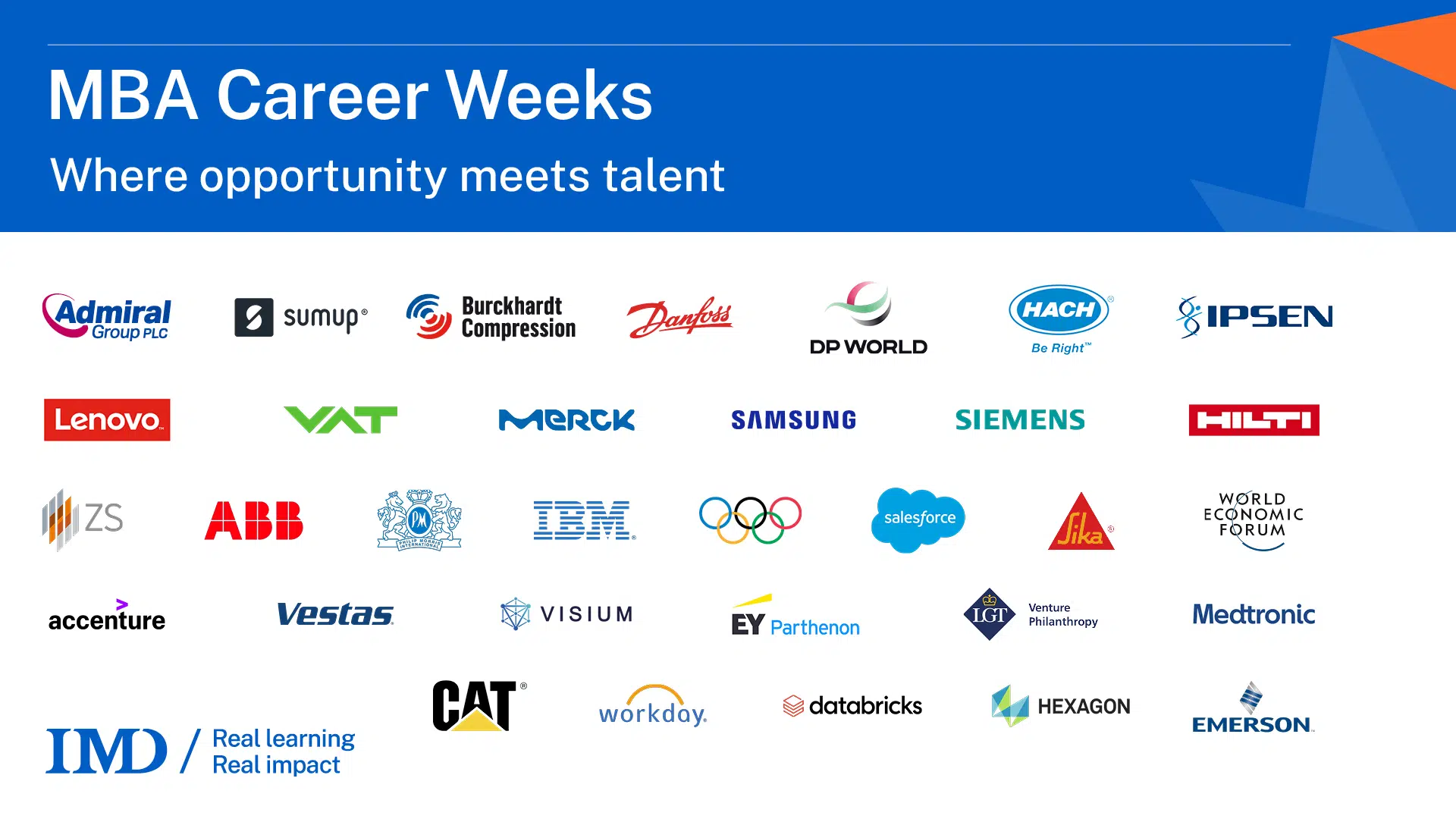
The companies that attended in 2025 are published, as a single image with no useful alternative text. We downloaded it, converted it and read it. It carries 32 logos, counted row by row: seven, six, eight, six and five.
By our reading, four of the 32 are consulting or advisory firms: ZS, Accenture, EY-Parthenon and Visium. The rest are manufacturers, technology companies, consumer goods firms, a bank-adjacent foundation and two international organizations. No large strategy house of the kind most case candidates target appears on the poster.
Three cautions belong with that count. We did the classification into consulting ourselves and the school labels none of the logos. The poster does not claim to be an exhaustive list of recruiters. And attendance at an event is a long way from hiring, so a firm on the poster may have taken nobody and a firm absent from it may have taken several.
What the count does support is a planning decision. If 15 percent of a class joins consulting firms and the flagship on-campus event shows four consulting names out of 32, then a meaningful part of consulting recruiting at this school happens away from that event. Budget time for an off-campus search rather than treating Career Weeks as the whole channel.
Are you ready to get an offer at a consulting firm?
What the firms publish, since the school publishes no interview detail
IMD describes a three-phase career program, from Explore through Prepare to Execute, and states that Launch Week covers "market trends, job search strategy, and transferable skills". None of that describes what a case interview contains. The firms do.
Accenture, which is on the 2025 poster, publishes the only case duration in our corpus. Its case workbook, checked 29 September 2026, states that "case interviews typically last from 45 to 60 minutes, with a focus on the case itself lasting 30 to 45 minutes", and that "the cases given tend to be real business situations, often drawn from the interviewer's actual project experience".
Roland Berger, whose German-speaking market overlaps directly with the Swiss one, publishes the only application lead time we have found from any firm. Its application FAQ states: "In general, the process will take around six to eight weeks (from submitting your application to signing the contract) and you should apply four to six months before your ideal start date."
Read that against a one-year degree that runs Career Weeks in September. Four to six months ahead of a summer start date puts the application at the beginning of the academic year, which is roughly when Career Weeks happens and long before most students feel ready.
The same FAQ settles a question that recurs at IMD, where the class arrives with six years of experience from many fields: "Half of our consultants have backgrounds in engineering, natural sciences, social sciences, or the humanities."
Deloitte publishes what the working headings of a case are, in its case prep tool: "Clear thinking", "Strategic framing", "Practical judgement", "Summary analysis", "Final recommendations". The spelling of the third belongs to the firm. That page also states the tool "is not an assessment and we do not track your responses or results", which is worth knowing before you treat it as a scored rehearsal. Checked 29 September 2026.
Put those three together and you have a duration, a lead time and a set of headings, all from firms and none from any school in this batch. That asymmetry is consistent across the corpus: schools publish outcomes and firms publish process.
Preparing when the clock is twelve months and the calendar is one word
IMD publishes a month for Career Weeks and nothing more precise, so there is no date to count backward from. Diagnose instead, and let the result set the schedule.
Run one short exercise of each type in a single sitting and note which dimension each one exposes.
- Math. A timed set done aloud, because arithmetic that only works on paper fails in a room.
- Structuring. Ninety seconds to write, then present it without reading.
- Brainstorming. Push for volume first, then sort what came out into named groups.
- Exhibits. One chart with the caption hidden, and give the implication before the description.
- Synthesis. A recommendation stated first, followed by the evidence and one risk.
- Market sizing. One estimation chain, with the unit written next to each step.
One full mock case gives you a single verdict on the whole performance. Six short exercises give you six named causes, and only the second kind tells you what to do on Tuesday.
Scope, weighted, and why it belongs on this page
The weights below are read from src/lib/grading/rubrics.ts and they are ours. IMD publishes no rubric, and no firm on its Career Weeks poster publishes one either, so any scoring scheme presented as a firm's was made up.
| Dimension | Weight, market sizing rubric |
|---|---|
| Assumption chain | 30 |
| Scope | 25 |
| Arithmetic | 25 |
| Sanity check | 20 |
Scope carries 25 points, which is the weight on saying exactly what population you are counting before you count it. This page is an extended example of what happens without it: 103 graduates, 20 percent, 15 percent and 80 percent are four correct numbers over at least three different populations, and combining any two of them produces a confident falsehood.
Sanity check carries 20, and it is the habit of asking whether a result can be true at all. Run the math drill and the structure drill once each and read the dimension each flags. All six rubrics and their weights sit on how an answer is assessed, and the drills open in the tools with no account. What they do not do: no live interviewer, no business knowledge teaching, and none of our six assessment simulators is live today.
Six things IMD does not publish, and who holds each
- Any salary in Swiss francs. The Career Development Center holds the survey the $180,000 came from.
- The purchasing power parity factor, source and vintage. Without it the dollar figure cannot be reversed.
- The class behind the banner figures. The 92 percent and the $180,000 carry no year.
- The denominator of the placement percentages. A headcount of 103 is published and never tied to the shares.
- The firms that hired. The statistics carry a "Top hiring companies" heading whose content is a strip of logos, which no text extraction returns.
- A 2025 or 2026 edition. The download still serves the 2024 file.
One control stays red here by design. We hold no independent first-hand account of consulting recruiting at IMD. The session's search quota was spent before this page was opened, the forum archives refuse our user agent, and the student blog posts on the school's own site are edited and published by the school. A 2025 Career Weeks video sits on the careers page without a transcript, and we do not reconstruct quotations from video. The attempts are written down in the research file.
What we had wrong on this page until today
1 October 2026. Rewritten after the career statistics were opened for the first time. The previous version ran 416 words and told readers that it would not report placement figures or name recruiting firms, on the grounds that the information belonged to the careers office and we could not verify it.
The school publishes the figures, and the path to them is three redirects long. The download button points at a short link, the short link lands on a document viewer, and the viewer's HTML holds the real file address under a different identifier from the one in the visible URL. Guessing the file path from the viewer address returns 404, which is exactly the outcome that makes a previous attempt look like proof of absence.
There is a second lesson in the Career Weeks list. That content is an image, published with alternative text that names the school rather than the companies, so it is invisible to every text tool. Converting it and reading it took two commands. A page that concludes "the school does not say which employers attend" would have been wrong, and the school does say, in a format that only a human eye or a conversion step reaches.
Before you go: where do you actually stand?
A short diagnostic: a few questions about where you are, one real case, and a score on the dimensions firms publish. Free, no card.
Sources
Primary sources only: the firm, the test vendor, or the institution concerned. Each carries the date we last read it.
- go.imd.org/career-development-career-statistics-2024every figure attributed to the career statistics on this page: the class of 2024 headcount of 103, the 37 percent women and six years of average experience, the 80 percent three-month offer rate, the eleven-row function table including consulting at 20 percent, the nine-row sector table including consulting at 15 percent, the five-region destination split, the 30 percent employed in Switzerland, and the one-year program descriptionchecked 2026-10-01
- imd.org/degree/mba/career/development/the three undated headline figures quoted here, namely the 80 percent offer rate, the 92 percent switching rate and the $180,000 median salary marked USD PPP, plus the September timing of Career Weeks and the three-phase career programchecked 2026-10-01
- imd.org/wp-content/uploads/2025/09/20250912-MBA-career-weeks-Companies_1920_x_10803.jpg.webpthe count of 32 companies shown on the 2025 Career Weeks poster and the identification of the four consulting or advisory firms among themchecked 2026-10-01
- ecb.europa.eu/stats/eurofxref/eurofxref-daily.xmlthe market rate quoted here for anyone converting their own franc figure: 1 EUR = 1.1355 USD and 1 EUR = 0.9478 CHF on 30 September 2026, giving 1 CHF = 1.1980 USDchecked 2026-10-01
- rolandberger.com/en/Join/Your-application/FAQ/the firm's published application lead time and its statement on the background mix of its consultants, both quoted verbatimchecked 2026-09-29
- accenture.com/content/dam/accenture/final/a-com-migration/manual/r2-2-r2-3/pdf/careers/pdf-14/Accenture-FY19-Case-Workbook.pdfthe only published case interview duration in our corpus and the firm's statement on where its prompts come from, both quoted verbatimchecked 2026-09-29
- usrecruiting.deloitte.com/case-prep-toolthe five named headings the firm publishes for working a case, quoted verbatim, and its statement that the tool is not an assessmentchecked 2026-09-29
Edits the firm and case guides on this site. Reads each claim about a recruiting process back to the firm's own page before it is published, keeps the source ledger dated, and owns the corrections.
How this guide was made
- Written against a published editorial process, not from memory. Every claim about a firm's process is either linked to that firm's own page or absent. We say what we could not verify rather than filling the gap.
- Each page carries a dated source ledger, below. When a firm changes a programme or a deadline, the date tells you how far to trust what you just read.
We look for first-hand candidate accounts for every firm guide. Where we found none we could source, the page says so and carries the firm's own words instead. Nothing here is dressed up as testimony, and if your own experience contradicts what you read, tell us and we will correct it and date the change.
Something wrong or out of date here? Tell us and we will correct it and date the change.